

 |
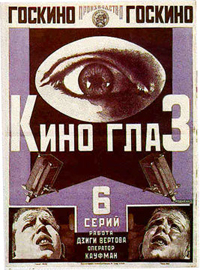
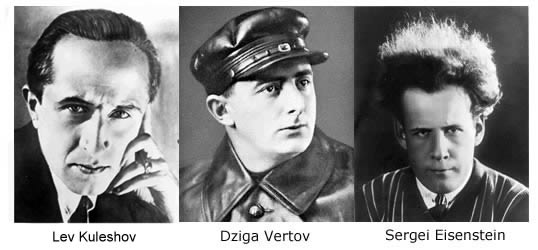
The films of Soviet Russia of the 1920s revolutionized cinema. Their breakthroughs are still being used today. In this class, we will study several of these ground-breaking films. Many of the Russian directors that we will study also wrote extensively about the art of cinema. They were both theorists as well as artists. Since the majority of the great Soviet films of this period are products of highly-developed written film theories, it is very important that you prepare for the viewing of these films by first reading what Donald Cook has to say in your textbook. Here are the reading assignments for Soviet Cinema: Dziga Vertov and the Kino Eye on pp. 116-118 Sergei Eisenstein pp.122-155 Also there are two online readings regarding "The Kuleshov Experiment" which you can read by clicking on the links below. |
| Assignment One: In the Beginning -- The Kuleshov Experiment |
| Watch "The Kuleshov Experiment/Effect" below. Also read about the experiment and the effect in your textbook as well as here. and here. |
| There will be a quiz about "The Kuleshov Experiment/Effect" on November 2, 2011. |
| Assignment Two: Eisenstein and Potemkin |
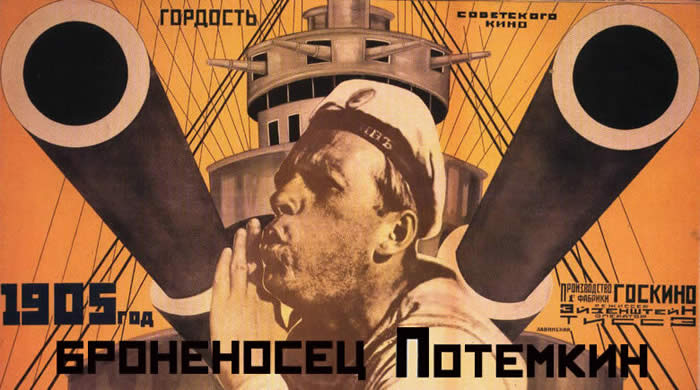
| In class you will watch scenes from The Battleship Potemkin (1925) directed by Sergei Eisenstein. |
 |
After viewing scenes from The Battleship Potemkin, answer the following questions: 1. Describe how Eisenstein adapted Karl Marx's social dialectical progression of thesis, antithesis, and synthesis into the world of film in order to formulate an editing style and a school of thought that now goes by the name of "Soviet Montage." 2. How is "Soviet Montage" evident in "The Odessa Steps" sequence? Write a well-developed essay in which you describe this scene in detail from the point of view of how it is a textbook example of "Soviet Montage." 3. Critic Roger Ebert writes that The Battleship Potemkin "has its greatest impact not by the smooth unrolling of images, but by their juxtaposition to one another." Use the plate-smashing scene as the basis of your essay. Do you agree, or disagree with Mr. Ebert's statement? Write a well-developed essay that supports your thesis. Download Battleship Potemkin Answer Sheet |
| "The Odessa Steps" Sequence from Potemkin | "Breaking a Plate" Sequence from Potemkin |
| This assignment is due on November 7, 2011. |
| Assignment Three: French Montage -- Abel Gance's Napoleon |
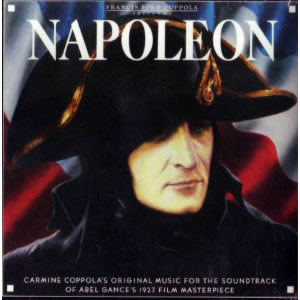 |
Watch the two extended sequences from the French film Napoleon (1927) directed by Abel Gance. Answer the following question: The use of Montage by French director Abel Gance in the film Napoleon is very different from the way the Russians employ the technique. Describes these differences by contrasting Abel Gance's film to Eisenstein's Potemkin. Download Napoleon Answer Sheet |
| This assignment is due on November 9, 2011. |
| Assignment Four: |
| In class we will watch a scene from October (1928) directed by Sergei Eisenstein. |
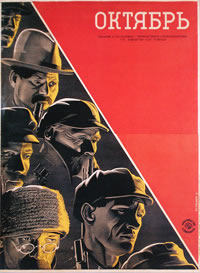 |
After viewing a scene from October answer the following question: This sequence is a classic example of Eisenstein's "Intellectual Montage." Clearly it has more meaning in it, than what it shows, i.e., it's more than just about a man going up the stairs! In a well written essay describe the scene in detail (including intertitles), and then go on to explain the real meaning of this sequence. Again, give details that support your findings. Download October Answer Sheet |
| This assignment is due on November 10, 2011. |
| Assignment Five: Soviet Propaganda meets Soviet Montage |
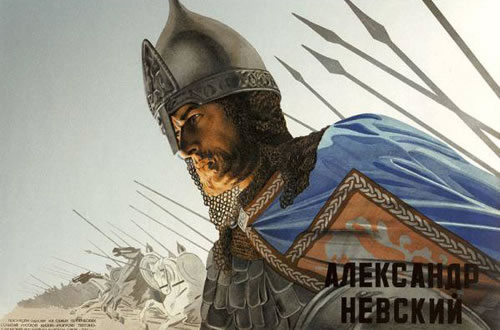
| On the eve of World War II, as the Soviet Union was being threatened by Hitler's German militarism, Sergei Eisenstein makes this film. Watch and study Sergei Eisenstein's Alexander Nevsky (1938) There will be a quiz on this film on November 15, 2011. |
|
| Assignment Six: The Legacy of Soviet Montage in Modern Times |
 |
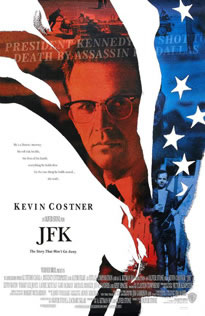 |
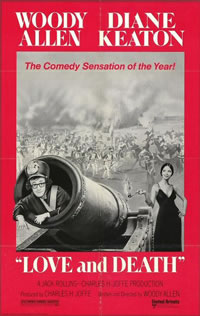
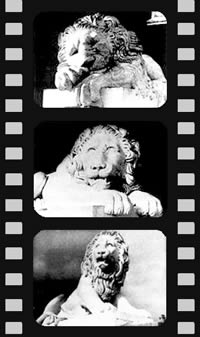
| Explore how modern and contemporary filmmakers have used the lessons of Soviet Montage in their films. Watch Woody Allen's comedy Love and Death (1975) and an excerpt from Oliver Stone's JFK (1991). There will be a quiz on these two films on November 18, 2011. |
 |
List of Assignments, Due Dates, and Point Value for each assignment: Quiz on The Kuleshov Experiment/Effect: November 2, 2011 (20 points) The Battleship Potemkin questions: November 7, 2011 (40 points) Napoleon question: November 9, 2011 (40 points) October question: November 10, 2011 (20 points) Alexander Nevsky quiz: November 15, 2011 (40 points) *** Bicycle Thieves visit to MoMA: November 16, 2011 *** Bicycle Thieves exam: November 17, 2011 (60 points) Love and Death and JFK quiz: November 18, 2011 (40 points)
|
Procedure: It is your responsibility to download each of the answer sheets in order to answer these questions. Make sure that you print each one on 8½ x 11 white paper. Make sure that you adhere to the above schedule. Please, do not type these assignments. Make sure that your work is written in either black or blue ink. Staple all pages before you get to class, if necessary. NB: Any deviation from the above guidelines will result in a loss of points. No late assignments will be accepted. Any work handed in late will receive a grade of 0%. |
| Go Back to Elements of Cinema HomePage |