 |
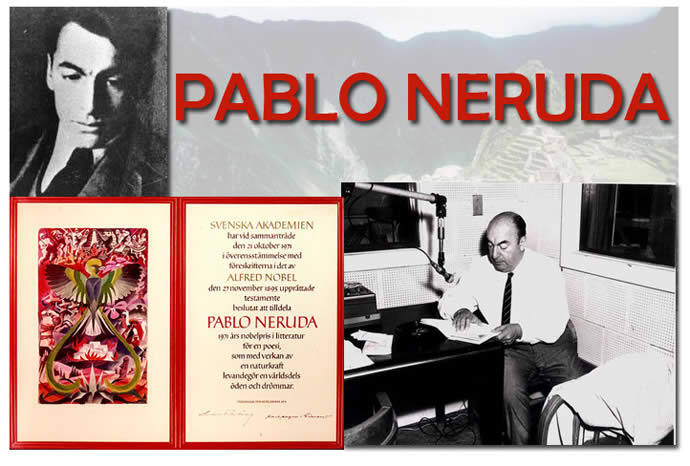
Pablo Neruda was born in the town of Parral in Chile in 1904. He is often called the "Picasso of Poetry" for his ability to be in the forefront of literature, and for his talent to constantly change his style. He is a poet of many styles, many voices, and many works. He is one of the great voices of literature in the 20th Century. For his life-long excellence in poetry, he was awarded the Nobel Prize for Literature in 1971. He died in 1973. |
In this internet assignment you will study the life, politics, and works of Pablo Neruda. The first thing to do is to click on his name above and to read and study his biography. Then click on the words "Nobel Prize for Literature in 1971" and read the speech that he gave when he was awarded this prize in Stockholm, Sweden. |
 |
Pablo Neruda Simpsons Trivia In the Simpsons Episode where Bart sells his soul to Millhouse there is the following exchange between Bart and Lisa: LISA: You know, Bart, Pablo Neruda said that laughter is the language of the soul. BART: I am familiar with the works of Pablo Neruda. |
Now you are ready to read his poetry. You better have your Spanish-English, English-Spanish dictionary handy. It will prove to be very valueable in understanding Neruda's language. Students of Spanish all over the world are very lucky that the University of Chile has published the works of Pablo Neruda online in their extensive website. You will be using this site in order to read and study the following Neruda poems. From his poetry collection Veinte poemas de amor y una canción desesperada (1924) read the sixth poem of that collection: "Te recuerdo como eras en el último otoño." Answer the following questions: 1. ¿A quién cree Ud. que está recordando el poeta? Indique partes del poema que ilustran su opinión? 2. En este poema, ¿qué representa el otoño para el poeta? 3. ¿Cree Ud. que el poerta está feliz en este poema? ¿Por qué? From his poetry collection Residencia en la Tierra (1935) read his poem "Walking Around." Answer the following questions: 4. ¿Por qué cree Ud. que el título de este poema es en inglés? ¿Hay algo en el poema que indica por qué el poeta decide usar el idioma inglés para titular su obra? 5. ¿Qué quiere decir el poeta cuando escribe «Sucede que me canso de ser hombre»? 6. Hay muchas imágenes de horror, y también muchas imágenes surrealistas en este poema. ¿Cuáles son algunas de estas imágenes? The best known and longest book of poetry of Pablo Neruda is Canto General. In this massive work he tried to include everything about the continent of America. It is an encyclopedia in poetry, a love song to the continent where we live. From the section called La lámpara en la tierra read the poem "Amor América (1400)" and answer the following questions: 7. ¿Cuál es el tema de este poema? 8. ¿Qué quiere decir el poeta cuando escribe «Antes de la peluca y la casaca fueron los ríos»? (Hint: the words "peluca y casaca" refer to two items associated with Europeans.) 9. ¿Qué quiere decir el poeta cuando escribe «Tierra mía sin nombre, sin América»? From the section called Alturas de Macchu Picchu read the seventh poem of that section "Sube a nacer conmigo, hermano" and answer the following questions: 10. Cuando Neruda visitó Macchu Picchu, él experimento (experienced) un tipo de renacimiento (rebirth). En el poema, ¿qué nos invita el poeta que nosotros hagamos? 11. Indique Ud. algunas referencias bíblicas que Neruda usa en este poema. 12. En su opinión, ¿qué representa la antigua ciudad inca para el poeta? NB: If you are not sure or do not know what Macchu Picchu is, then click here. It is necessary to know about Macchu Picchu in order to understand and appreciate Neruda's poem. The Assignment Study the life of Neruda, the speech he gave when he won the Nobel Prize for Literature in 1971, and the poems above. Answer all the questions above on looseleaf with complete Spanish sentences. Make sure that you write both the questions and the answers, and that your work is written with either blue or black ink. No pencil. Please staple the pages of your work, in order, before you get to class. Hand in this work on February 28, 2014. On this day you will take a quiz based on this material. You are allowed one handwritten sheet of looseleaf with notes. No typed sheets will be allowed. The format of the quiz is Spanish questions to be answered in Spanish with full sentences. Grading The written assignment is worth 40 points. The quiz is worth 60 points. |
Go back to Mr. Vargas' Spanish 3 Honors Online